Description
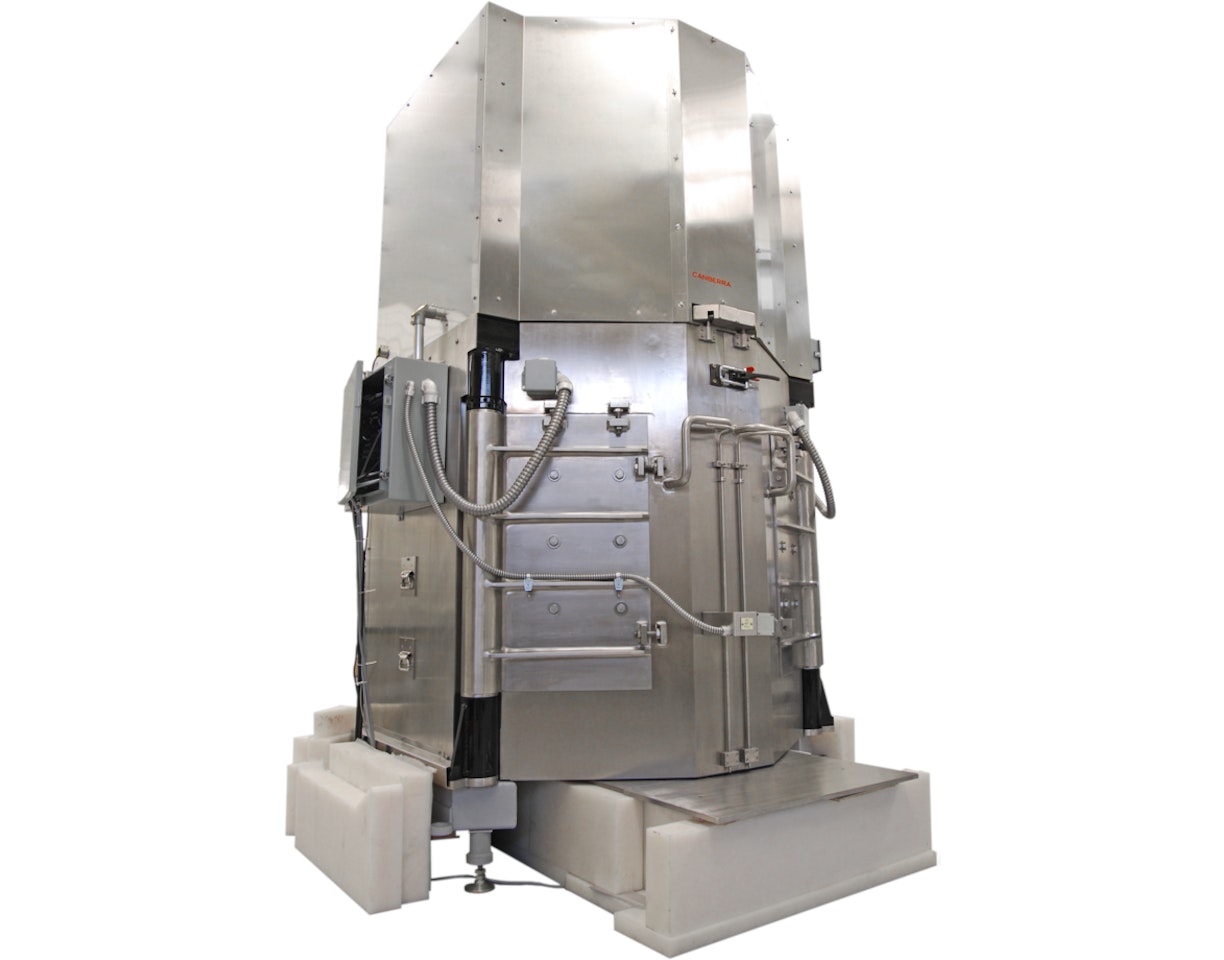
The JCC-41 counter, based on Monte Carlo design calculations performed at Los Alamos National Laboratory1, measures the effective 240Pu mass in a sample by detecting coincidence neutrons from the spontaneous fission of the even numbered isotopes of plutonium.
The JCC-41 unit is designed for in-plant measurements of large plutonium samples (up to several kg Pu), but can be used for plutonium waste samples with milligram quantities of plutonium. The JCC-41 counter has a higher efficiency, larger sample size and flatter axial response than the previous transportable unit. The system consists of a JCC-41 counter head and sample hoist mechanism.
The JCC-41 counter has a cylindrical-shaped sample cavity intended to assay plutonium samples including PuO2, mixed oxides (PuO2-UO2), metal carbides, fuel rods, fast critical assemblies, solution, scrap, and waste. A cadmium sleeve surrounds the sample cavity to prevent the reentry of thermalized neutrons into the sample, which could induce fission in the sample and adversely affect the results.
Outside the cadmium sleeve is a polyethylene/cadmium liner to flatten the axial response. Twenty-four 3He tubes are embedded in the high-density polyethylene. The tubes are arranged in a single ring around the sample with optimal spacing between the tubes for maximum counter efficiency.
The tubes are divided into six groups of four with each group wired together and connected to one of the six Amplifier/Discriminator circuit boards, which are mounted inside a high voltage junction box. LED indicator lights are placed externally on the junction box to indicate proper operation of each pre-amp channel. Electrical connections between the JCC-41 counter and the JSR-15™ unit include +5 V and HV. The combination of signals will be combined into a logical OR.
A cadmium sleeve wrapped around the outside of the JCC-41 unit provides radiation protection for personnel as well as background reduction.
The external polyethylene shielding and special design (graphite end plugs and polyethylene/cadmium liner) give uniform response axially over the sample cavity, making the counter relatively insensitive to matrix effects.
A JSR-15 Neutron Analysis Shift Register, a computer and analysis software are required for coincidence counting but are sold separately.
1 Menlove, H.O., Palmer, R., Eccleston, G.W., and Ensslin, N. (1989). Flat-Squared Counter Design and Operation Manual. Report LA-11635. Los Alamos, New Mexico: Los Alamos National Laboratory.